

Hot Water Irrigation Is Just Irrigation
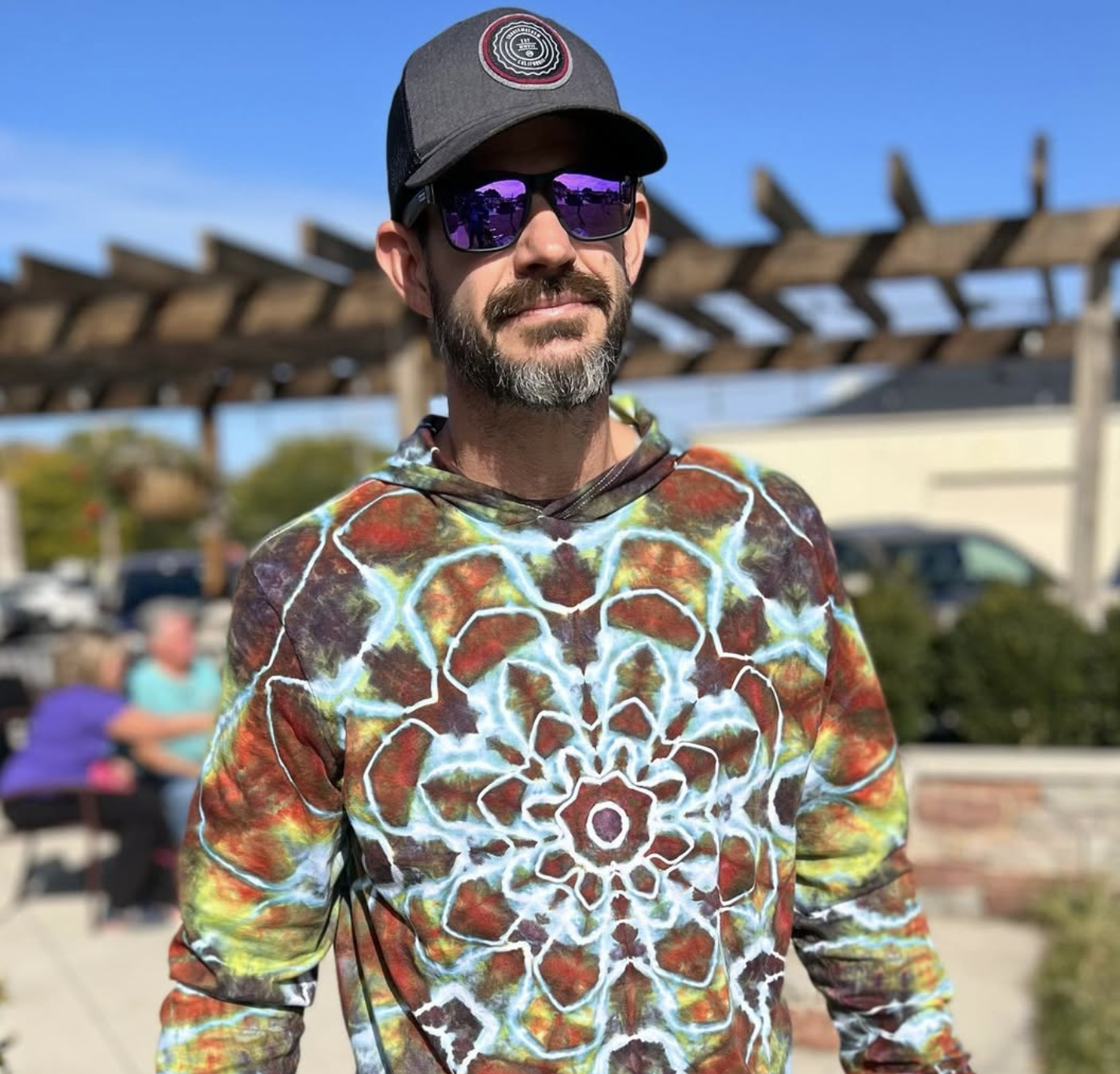
There is a technique out there called hot water irrigation.
Look at what happened in that name. A temperature got welded onto the front of a method and became part of what the method is.
It is irrigation. That is the technique. Moving dye through a folded piece using liquid.
Search it and you find the answer sitting in the cons
Look up hot water irrigation and you will find write-ups that list what is good about it and what is bad about it.
Two things show up on the bad side over and over. It uses more dye than other methods. And the washout takes longer.
Both of those are real. People are not making them up.
But neither one is caused by irrigation. They are both caused by the hot water, and by the heavy soda ash that usually rides along with it. Turn those two dials down and both problems go away.
So the answer was already written down. It just got filed under what the technique costs you, instead of under what that one setting costs you. The rest of this post is why.
I came up on hot water
This is not an outsider's complaint. I learned this on the One Hour Tie-Dye forum, where John Kobrzycki laid the whole thing out in the open. His ratios, his process, no holding back. Justin Biffer came up through the same place. My first exposure to any of it was mixing dye and soda ash together, dropping it on a piece, and spraying the daylights out of it with 150 degree water.
I thought it was wild. Then I got addicted to it, because hot water does something specific and it does it fast. Color everywhere, sinew lines coming out bone white, effects that do not happen on their own.
So none of what follows says heat is bad. Heat works, and I will show you exactly where I still use it hard. The argument is narrower than that. Temperature is a setting. Calling the setting the technique is what stops people from ever moving it.
Watch it happen instead
Everything below this is also on camera, run as live experiments on real shirts instead of worked out on paper. If you would rather see it than read it, start there and come back.
2.1, All the Forms of Tie Dye, and How This One Closes the Gap. The delivery methods, the moisture rule, and where irrigation sits among the other forms. https://www.youtube.com/watch?v=BomFzZbY9QM
2.2, What Happens When You Skip the Soda Ash. Takes the soda ash dial all the way to zero to show what a piece does when the bonding reaction never starts. https://www.youtube.com/watch?v=B50g-Y2APew
The rule the whole method rests on
Moisture is your enemy. More particularly, moisture without dye in it is your enemy.
Any moisture that gets into the piece needs to have dye in it. Water without dye still fills the space it lands in, and once that space is filled it will not let you get dye into the white later.
So you use the minimum amount of liquid required to get dye into the garment. That is the core of irrigation and everything else follows from it. You are not soaking a shirt. You are using only as much water as it takes to carry the dye where it needs to go, because every ounce past that is taking up room the dye needed.
Hold onto that. It is the thing hot water breaks.
Two dials, not one
Of all those variables, two do most of the work, and they are almost always discussed as if there is only one.
Temperature. Cold tap water up to 150 and beyond.
Soda ash concentration. From none at all up to a ratio like half a cup to a tablespoon of dye.
Both of them do the same job to the chemistry. Both make the dye commit faster. Soda ash is what starts the bond, and it is brakes, not glue. Heat is the accelerator on the whole reaction.
What matters is that these are two independent dials, which means there are four corners, not two settings.
Cool water, low soda ash. The dye travels a long way, slow to commit, lots of movement and bleed.
Cool water, high soda ash. Locks in place cleanly without the thermal push on top of it. Workable.
Hot water, high soda ash. Commits on contact. Does not travel. This is where hot water irrigation lives as it is usually taught, and it is the one that causes people trouble.
Hot water, low soda ash. Open question. Speed and chroma without the brakes. This is the one I have not tried yet and want to.
Three of those four I have run on camera. Nobody talks about the grid. They talk about hot water irrigation as though picking the temperature picks everything else too.
Why the bottom right corner fights you
Irrigation depends on travel. The dye enters at the surface and has to work down through a fold, layer by layer, carried by water. That takes time and distance.
Run hot water with high soda ash and the dye bonds the instant it touches fiber. It commits at the surface. It never gets to the inside of the fold.
I ran this as an experiment. Half a cup of soda ash to a tablespoon of dye, tap water as hot as it would come, 126 degrees at the sprayer. On the surface it looked fantastic, intense and high powered, exactly the vividness that got me hooked in the first place.
Then look at the gutters under a Ron Star petal. The dye hit the top, struck immediately, and stuck. After that I was pushing fluid through a fold that had almost no dye left in the liquid, just soda ash and water. The gutters flooded with moisture carrying nothing, and that moisture locked everything up.
There was no fixing it. I could have sat on that shirt pushing dye through the top for half an hour and it would not have changed a thing. The path was closed.
So where does the water volume come from
This is the part that gets treated as technique when it is actually compensation.
If the dye will not travel on its own, there is exactly one way left to get coverage: force it. Sprayer cranked to high pressure to physically drive dye through fabric that has already started locking. Flip the piece and work the back. Run a second batch. And keep pushing water, until you are running gallons of water through a single garment.
A shirt does not hold gallons of anything.
Now, pressure does do something. I want to be fair about that. Crank a sprayer to high and lean on it and you will get some more fluid into the piece. Get some leverage on it, shove it around, work an angle, and you can push a bit further in than you could gently.
You are still not getting to the core. The core is locked and it is full of water. There is no amount of pressure that changes that, because the problem is not that the water needs a harder push. The problem is that the space is already occupied.
What that pressure mostly accomplishes is blowing dye off the shirt. It comes off the surface, off the outside of the fold, and into the sink. You are standing there watching color leave the piece while you try to force color into it.
And the fluid you do manage to drive in at that point is mostly just water, because a good share of the dye already got blown clear. That is moisture without dye in it, filling the last space you had left.
So you need more dye, because a lot of it never stayed on the shirt. And the washout runs long, because what did stay is sitting there unbonded and has to come out one wash at a time.
More dye and longer washout are not costs of irrigation. They are the price of forcing volume through a piece to beat chemistry you set too fast on purpose.
Read that back against the rule. Minimum liquid required. Running gallons through a piece is the exact opposite of the principle the technique is built on, and this setting requires it structurally. Not because anyone is doing it wrong, but because once the dye commits on contact, brute volume is the only lever left.
A bundle only holds what a bundle holds
Set the chemistry aside for a second and just think about the object.
You have a shirt folded into a bundle. A Ron Star, say. That bundle occupies a certain volume and it holds a certain amount of liquid, and that number is not large. Wet it out and it fills up like a diaper. You can feel exactly when it happens.
Once it is full, it is full. You can move things around at the edges, sure. But you are not pushing more liquid into the center, because the center is already packed and bound. There is nowhere for it to go.
So what are those gallons doing?
Not delivering dye to the middle. The middle stopped accepting liquid long before you got near the first gallon. Everything after that is running around the outside, washing over the fold, and going down the drain.
Here is the comparison that made this obvious to me. When I liquid dye a shirt, I might use a hundred milliliters. Maybe a hundred fifty. Two hundred if the fold is really loose. That is a whole garment, dyed, done.
A gallon is 3,785 milliliters. Call it twenty five times the liquid, for the same shirt. And a gallon is the low end of what this ends up taking.
Nothing about a folded cotton shirt changed between those two methods. The garment did not get twenty five times bigger. Its capacity did not change. So that volume is not a requirement of the fabric or the fold. It is what you have to do when the dye stops traveling and you have decided to make up the difference with water.
And every drop of it is moisture without dye in it by the time it reaches the parts of the shirt you were trying to fix.
Ice dye already proves you do not need force
Here is the part that should settle it.
Ice dye is the same delivery method. Dye moving through a folded piece, carried by water. The only difference is how the water shows up.
And ice dye water arrives as slowly as water can possibly arrive. A cube melting on top of a shirt, one drop at a time, over hours. There is no sprayer. There is no pressure. There is no volume. Nobody has ever ice dyed a shirt by blasting it.
Ice dye produces some of the deepest saturation in the craft anyway.
So if driving dye through a fold genuinely required force, ice dye could not work. It would be impossible. The fact that it works, and works well, is proof that the chemistry moves dye on its own when you let it.
Which means force is not a requirement of irrigation. Force is a workaround for a path you closed by setting the reaction too fast.
Chill out, drop the soda ash, and let the dye do what it does. That is all ice dye is doing, and everyone already accepts that it works.
Procion MX was built to work without the heat
Procion MX is a dichlorotriazine dye. Two chlorines on the triazine ring, both leaving groups, and that is the most reactive class in general use.
IICI invented the Procion class in the 1950s, and the point of it was that cotton could finally be dyed without a heated bath. That is a bigger deal than it sounds. Dyeing cotton before that meant heat and the equipment to run it, which kept the whole thing industrial. Take the heat requirement away and it moves to a bucket in somebody's garage. That is how these dyes ended up in the hands of people making tie dye in the first place. Room temperature is not a compromise for MX, it is the design condition. That reactivity is the entire reason the class exists and the entire reason it took over craft dyeing.
Vat dyes need heat. Disperse dyes need heat. MX does not.
Warming it does not unlock anything that was locked. The reaction was already fast enough at room temperature. Heat makes a fast reaction faster, and in a technique built on making dye travel, faster is not automatically better.
The dye you lose is dead, not just misplaced
Worth knowing what happens to all that dye once it leaves the shirt.
Under alkali, cellulose hydroxyls attack the dye molecule, kick off a chlorine, and form a covalent bond. That is the color you keep. But hydroxide and plain water attack the same site on the same molecule, and when that happens the dye is finished. Still colored, no longer capable of bonding to anything.
Water is everywhere in that shirt. Reachable fiber is not. So the destructive reaction has a standing advantage over the useful one, and heat pushes it harder.
Which means the dye you blew off the piece is not sitting in the sink waiting to be useful. It is spent. And the dye still in the shirt that never found fiber is spent too, which is why the washout keeps going and why more water will not bring that color back.
What most people should actually do
If you are struggling with irrigation and somebody told you to run hot water, try this instead: take cold water out of your faucet and pour it on.
That is not a simplification for beginners. Cold water gives the dye time to travel, which is the thing the technique needs most, and it removes the variable that is causing your coverage problem. You will get better penetration on your first try than you will get fighting a 150 degree sprayer.
Hot water has a time and a place, and the effects it makes are genuinely cool. If you want to light a shirt up, hot water will light a shirt up. But as a default recommendation handed to somebody learning this, it does more harm than good, and it has left a lot of people convinced irrigation is harder than it is.
Where I do use heat, hard
After the dye is placed, not while it is traveling.
I run what I call a boil batch. Pot of tap water as hot as your faucet will give you, half a cup of soda ash in it, half a cup of soda ash in it for insurance even when there is already enough in the piece, then onto the stove on high and brought to a boil. About fifteen minutes.
That is deliberately exploiting the thermal variable, the same one I just spent this entire post telling you to be careful with. The difference is the stage. During delivery, speed works against you because the dye still has somewhere to be. During cure, the dye is already where it is going to be, and speed is pure benefit.
Application temperature and batch temperature are two separate decisions. They get discussed as one and they are not.
Why I do not tell people what colors I use
Every color has its own personality.
They do not respond to temperature the same way. They do not want the same soda ash. They split differently, they move through a fold differently, some of them fight their way into tight spaces and some of them refuse. Two dyes that look like the same red in the jar will behave nothing alike at 98 degrees.
I spend a huge amount of time dissecting colors. That is most of what I am doing when you see me run the same color over and over again. First time out I usually do not like what I get. Second time I try to fix one thing. Third, fourth, fifth, and somewhere in there I start to understand what that dye actually wants. What it likes for soda ash. What it likes for temperature. And once you know that, you can light it up.
So when somebody asks me what color that is, my answer is that it does not matter.
I am not being cagey. The answer genuinely will not help you. Knowing the name of a dye tells you nothing about how it behaves in your water, at your temperature, in your fold. That information does not transfer. It only exists on the other side of running that dye five or six times yourself.
Pick a color. Any color. Do four or five shirts with it and pay attention. You will learn more from that than from any list of colors I could hand you.
That is the whole point of the series, honestly. I am not making it so people can follow my directions. I am making it so people understand the process well enough to go wherever they want with it.
Actually using the dials
Pick a number and write it down. A probe thermometer costs a few dollars. My working example is 98 degrees, which is deliberately not 150 and deliberately not ice water. Knowing the number is the difference between running an experiment and collecting anecdotes.
Move one dial at a time. Same fold, same dye, same wash procedure. If you change the temperature and the soda ash ratio together you cannot read the result.
Watch your liquid. If a piece is taking way more water than it should, that is the signal. It means the dye is not traveling and you are compensating with volume.
Judge the finished piece. Wet fabric loaded with unbonded dye looks saturated. That holds right up until the third wash.
Two dials, four corners, and most of the space between them has never been mapped. That is the fun part.
Episode 2 of the Framework is where all of this actually happens on camera. 2.1 is at https://www.youtube.com/watch?v=BomFzZbY9QM 2.2 is at https://www.youtube.com/watch?v=B50g-Y2APew


Comments